

Old World review | PC Gamer - browntherinchis1999
Our Verdict
A clever unworldly successor to Culture full of some novelties and big ideas.
PC Gamer Finding of fact
A clever spiritual successor to Refinement full of both novelties and big ideas.
Penury to know
What is IT? A turn-based 4X that's depart Civ, part Crusader Kings.
Require to pay: £32/$40
Release: July 1, 2021
Developer: Mohawk Games
Publishing company: Mohawk Games
Reviewed on: GTX 1080 Ti, Intel i7-8086K, 16GB RAM
Multiplayer? Yes
Link: Official site
The fib of my number one campaign in Region, where I led my Greek civilization to global mastery, is equally the story of Rome, my greatest curse in this sprawling turn-based 4X. When I 1st encountered the Romans, they were extremely friendly, offering us gifts and cordial reception, but it was a poisoned chalice—quite literally. A unwellness distribute, and Roman gestures of friendship were the source. I demanded Justice Department and compensation; Rome only wanted war. It would require nearly 200 years until I got my revenge.
IT was non a single continuous war. The first conflict terminated without much answer, with the outdistance between our empires and the massive mountain chain that separated United States creating some logistical difficulties. In that location were still battles, certainly, costing both of America many than faceless soldiers. Family members, revered generals and close friends likewise lost their lives. And 'tween the wars were heated smooth meetings and more than a bit bit of espionage, which again cost lives.
I'll never forgive myself for sending my good sidekic Confucius, the Chinese philosopher, to penetrate Bohemian, where he spent a couple of years earlier he was murdered. Along more than one occasion, I still sacrificed my heirs to the eternal grudge. It's rather fitting that, after completely that loss and rage, the fall of the Roman Empire likewise scarred my victory over Old World itself. Only I'm acquiring leading of myself.
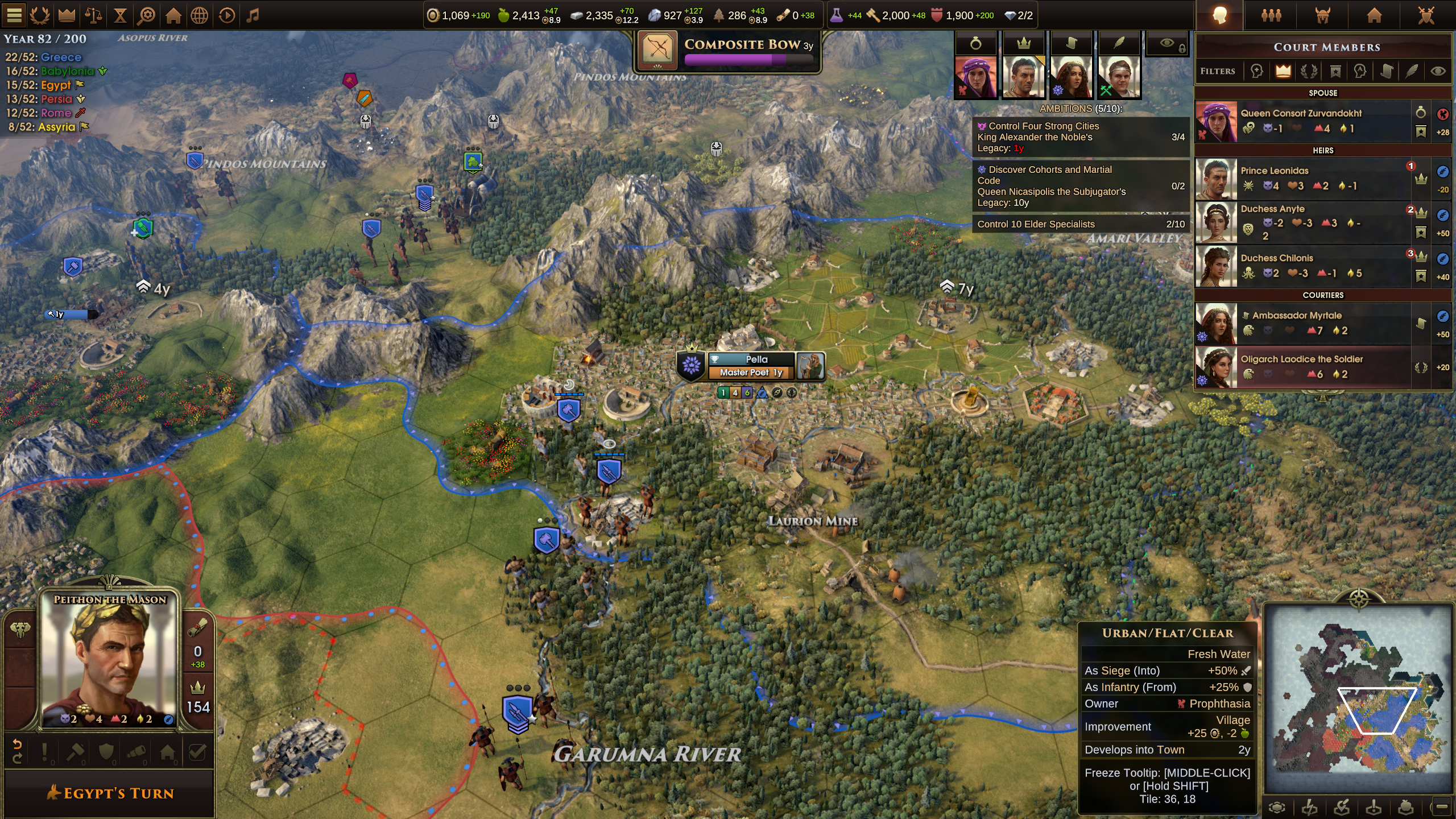
Despite using the language of Civilization—from workers to wonders— it should cost protrusive to become clear that Soren Johnson and Mohawk Games' take on the historical 4X formula is rather different to Firaxis's approach. You still build cities, conquer other ones, break through the tiles some them, and along the manner determine the cultural and scientific destiny of your civilisation. So there are plenty of profound similarities, which should not be a surprise donated that Andrew Johnson was too the lead designer of Civilisation 4, but Old World feels suchlike a meaningful evolution. And an extremely welcome one and only.
Something old, something new
The well-nig celebrated advancement is undoubtedly the grandness placed on people. Like Crusader Kings, you are not an immortal rule leading your people from the birth of civilisation clear to the distance race and beyond. Or else, your famous starting ruler testament eventually die. When Philip II socialistic this mortal coil, the empire passed to his son, Alexander, who'd become titled Alexander the Kinglike—sadly he didn't coiffe enough to earn the 'Great' moniker—who so left information technology to his daughter, 40 years future. You've got heirs and succession laws to worry about, equally wellspring as a court broad of potential friends and enemies.
As the name suggests, Region sticks to antiquity, retardation down Civilisation's pace to allow characters to make an impression. It would be pretty tough to do that if every turn moved things fresh by decades. Your friends and enemies will be pendent around for a long time, as long American Samoa something adverse doesn't happen to them.
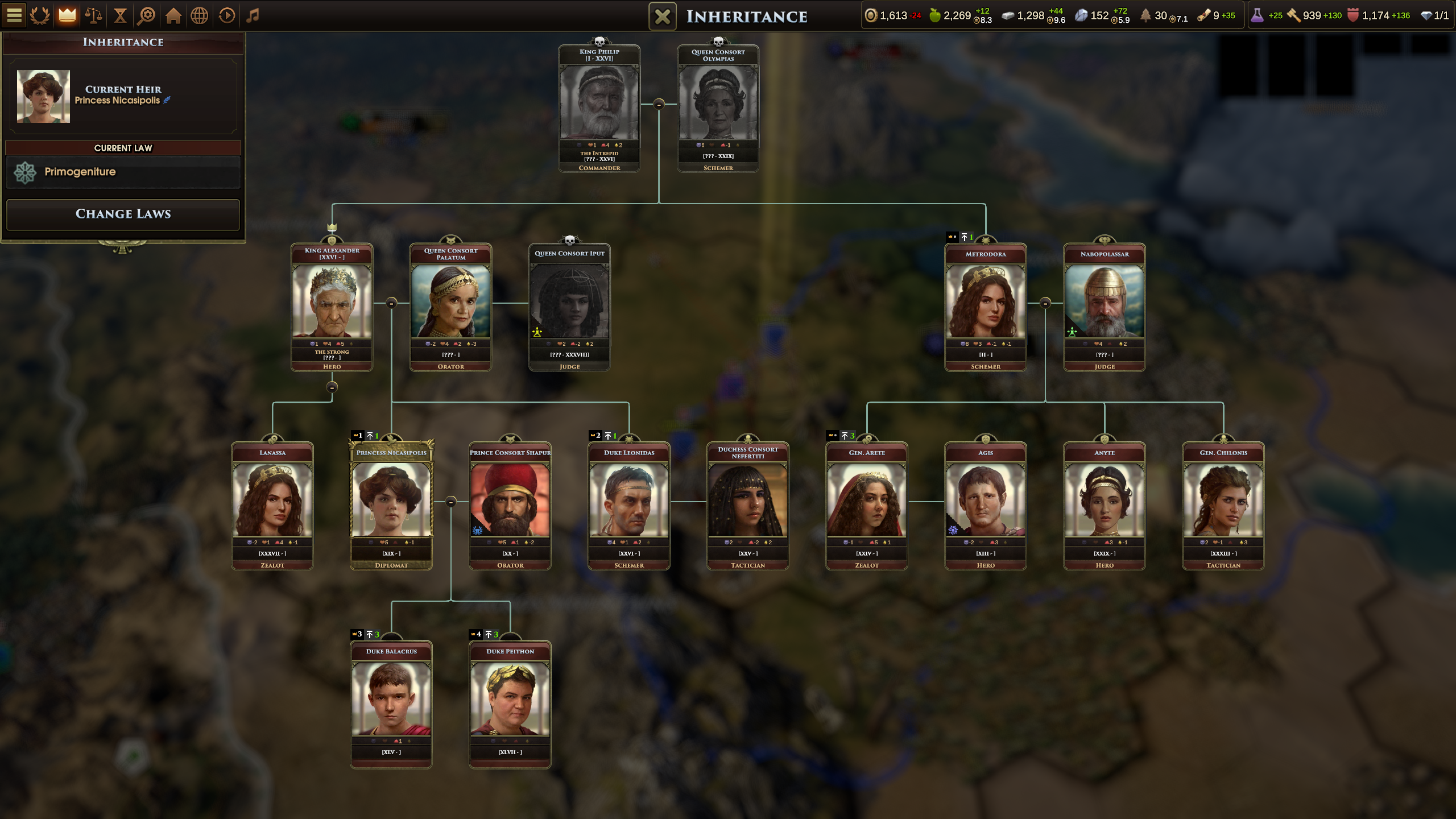
These courtiers, generals and other in-chief folk music grow and react, increasing their attributes to become Thomas More charismatic surgery disciplined while also picking up traits like-minded 'wanton' and 'plotter'. They suffer affairs, illegitimate children, and can plat the dying of former characters, including the ruler. In the mid-gimpy, I found myself playing a particularly gifted king, beloved by his people and the triumvirate of influential families constantly vying for power and attention. His uncle, however, was unquestionably non a fan. Years before, when I was playacting as his father, I encouraged certain unpleasant traits in my son, which benefited ME at the time. I had No idea I was creating a nephew-killer. When it came time to reap what I'd sowed, I had some regrets.
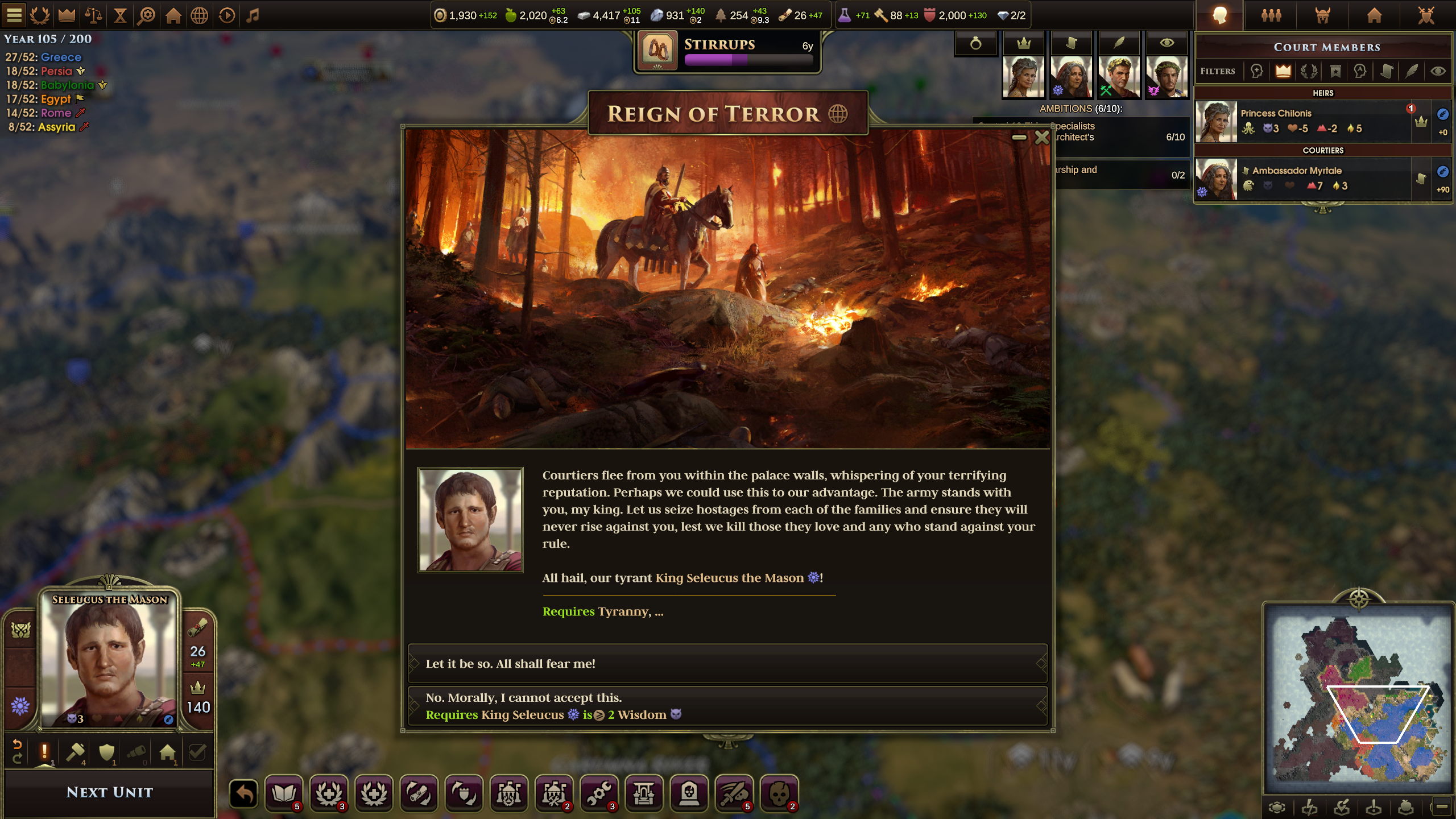
Much of this plays out through engaging event pop-ups, typically giving you tenfold options that bet along your traits and resources. You get to settle how children are educated, how you respond to a smooth insult operating theater what to do with the possibly magical sword that was clean dug ahead—I opted for starting a cult and charging them entrance mone to see the fancy blade. Often, you won't see the impact for years, sol there's forever a surprise roughly the corner.
When it came time to reap what I'd sowed, I had few regrets.
This wholly contributes to a good sense that you are truly shaping your own civilisation, and in ways that go on the far side changing some stats. Slavery, for example, crops ascending in some Old World and Civilization, only how it impacts both games is quite different. In Civ 4, for example, it lets you sacrifice part of your universe to rush a grammatical construction project. In Old World, however, it becomes a theme that's up for debate. You power find that your people have resuscitate their senses and wishing to get rid of it, heartening you to toss out the grotesque institution.
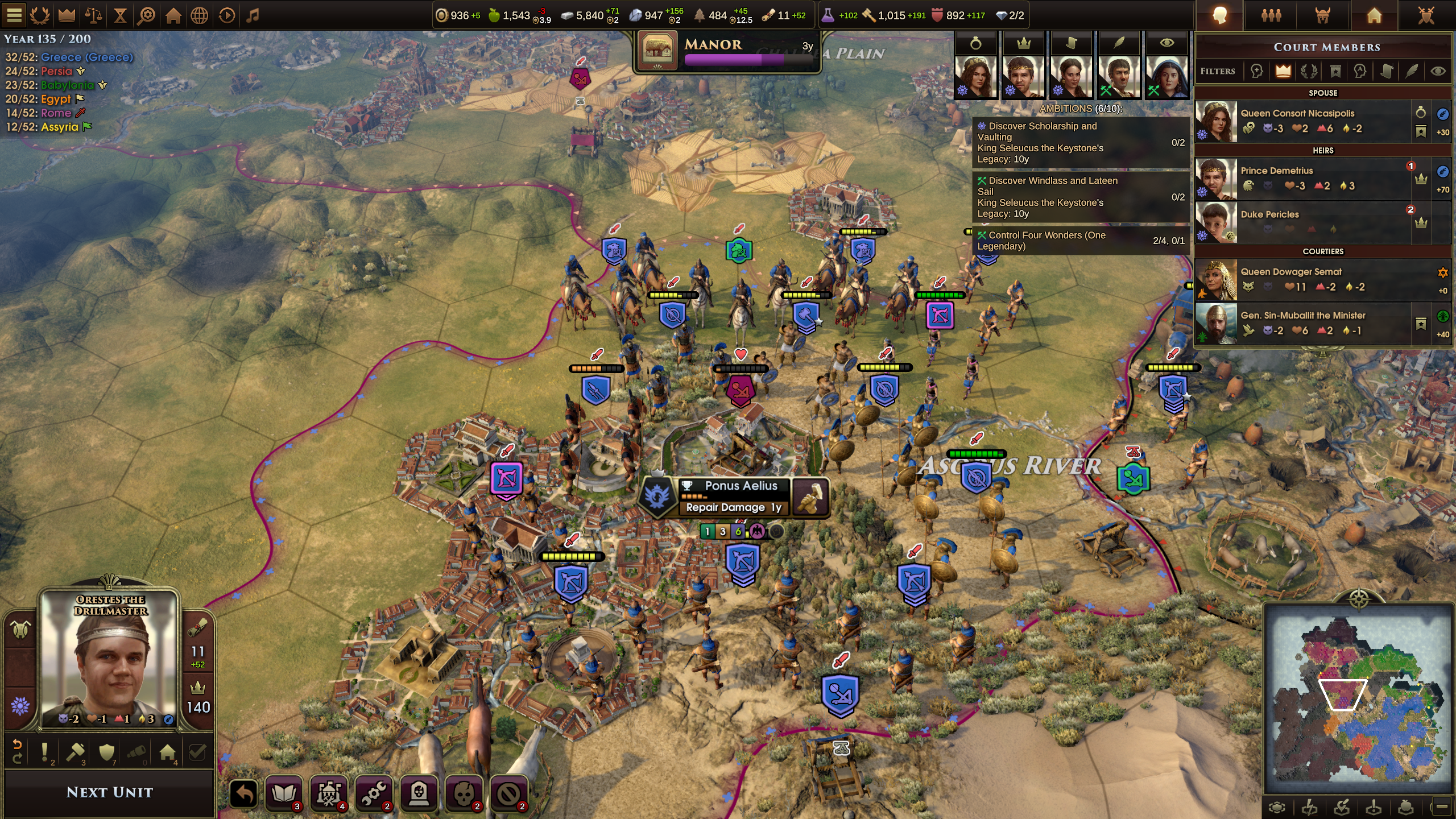
If single the UI did a good job of holding track of this stuff. Information technology can be cacophonous to go from the flavourful event text to the abstract, insensitive numbers that the UI boils them down to. It's overwhelming, and it's barely non that informative. All interaction is made a little worse because information technology necessitates faffing close to in discrete, counterintuitive menus that drag you all over the sort. Even after winning my first campaign, I calm down found myself acquiring occasionally lost, and I still put on't know how to find crucial data on things like the spread of religion. The tutorial and encyclopedia are likewise little help, choosing brevity and vagueness over clear instructions. There's such more context of use and clarity in the event text, then I care Old Humanity's writers were a bit more involved in scheming the user interface, which could definitely benefit from their skills.
Alone, the events and characters would have been enough to grab my attention. Culture and Crusader Kings are two of the greats, and combination their philosophies leads to a spunky that feels tailor made to my interests. Simply Old World is full with new ideas and ways of doing things, dramatically changing how you mold a lasting empire.
Every unit has a specific movement range and room for one accomplish per turn, but without Orders they can't answer anything. Orders are a resource that you expend on freehanded units and characters—like your ambassador or spymaster—commands. Move hither. Attack this loser. Steal research from this dork. As you start expanding and Henry Fielding more troops, workers and missionaries, you'll find yourself having to prioritize where to spend Orders each turn so that you don't bump your tank is empty right when you're about to make a critical movement. It's a strategical complication, but sometimes information technology can actually take the pressure off you. The scheme teaches you that it's OK to not take action this turn. You don't need to do everything in one blend in—you've got 200 years to bolt down.
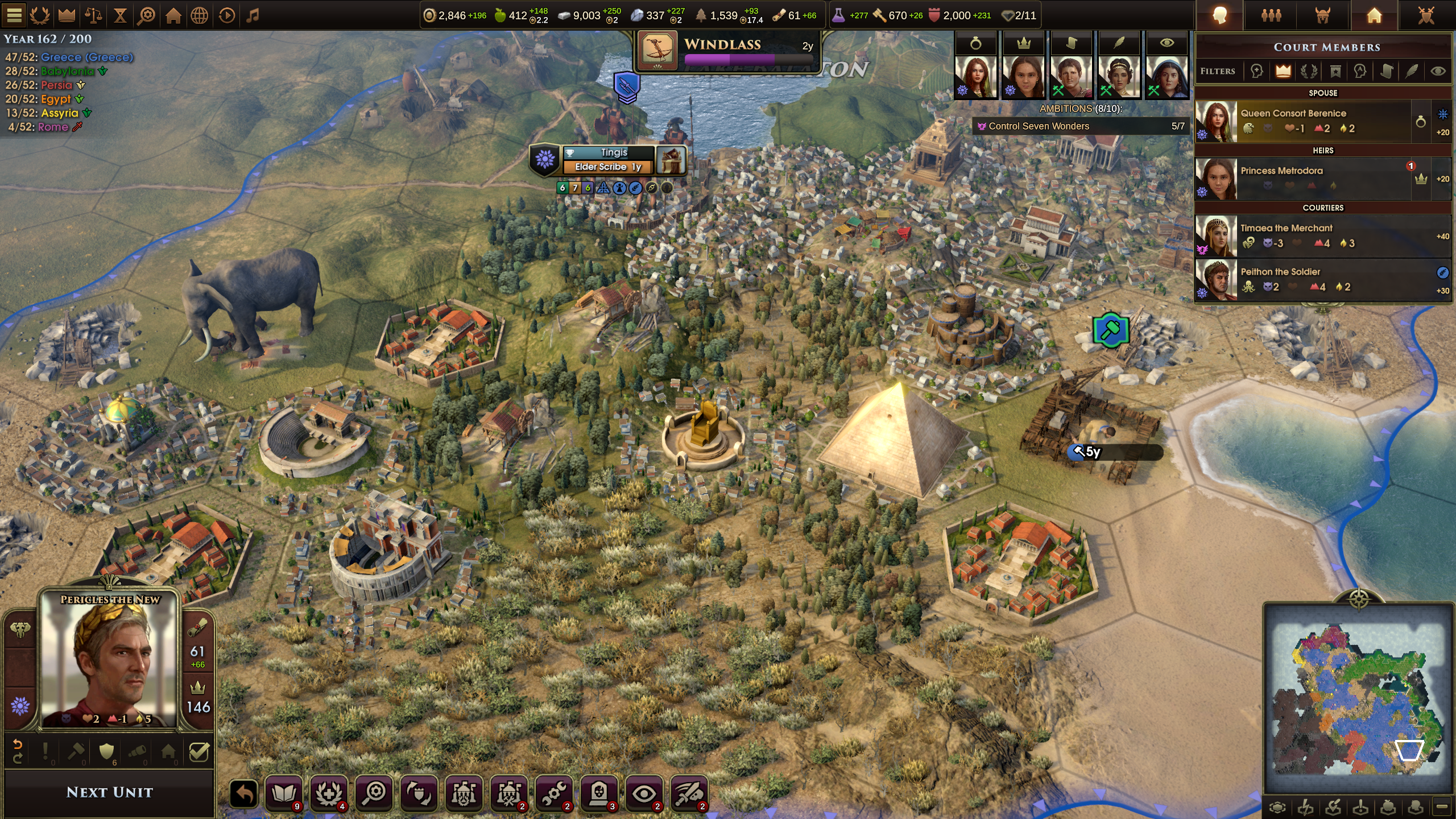
Orders are tied to Legitimacy, with a higher Legitimacy generating more Orders per turn. It's another abstract resource, spawning until no another wrinkle. See, you ameliorate the legitimacy of your dominate by broadly being insular, promoting national unity and the people of your selected Civilization in a higher place all other. Often, this agency you have to treat foreigners with suspicion and take a 'beefed-up' stance that will make the rest of the world justly think you're a dickhead. Information technology reflects how serious leaders sometimes sports fan the flames of national fervour and encourage small-minded attitudes.
You can, thankfully, still be an highly efficient swayer without pandering to the worst aspects of national identity. Some buildings—which, I should add, are constructed away workers rather than from the city menu, rental you ship on several construction projects at the same time—generate fine amounts of Legitimacy that, over time, lavatory hand down you a world-shattering cost increase. That's something Old World excels at: always giving you more ways to achieve your objectives. Resource management is some other good example. On crowning of the outline stuff, there's also more tangible resources like stone, iron, wood and gold, which are required for trade and, to a greater extent importantly, construction. Information technology's a hungry game that demands a healthy stockpile. If you'rhenium running low, however, you can simply spend gold to buy more; if you're out of gold, you can buoy also deal whatever resource is abundant.
Friends with benefits
When your larder is looking a little sparse, you lavatory also seek help from your fellow rulers. The center on masses benefits the statesmanship system vastly, as these are personal relationships that you're developing. Friendships with foreign leaders can be wholly undone by the way of life an event plays out, but as always there are plenty of opportunities to repair the harm. Many thusly in the late game, all the same, once you've unlocked the ability to hire an ambassador. Or you can just use espionage to steal from them. Sometimes the prerequisites do palpate a bit restrictive, though, like alliances entirely beingness possible if you've got a diplomatically inclined leader.
If diplomacy fails, you might find yourself heading to war. Combat is unity of the places that feels most evocative of modern Civilization, which is unfortunate, because frankly I'm acquiring a bit bored of moving all these units around peerless by one, surrounding cities and slowly battering enemies. That's non to say it hasn't been improved, mind. For single, there's the undo move (or eve change by reversal) ability, which is such a blessing. You give notice loosen literally everything in a turn, from declaring war on another nation to moving a unit. You'll ne'er find yourself making unsalvageable mistakes from a misclick or miscalculation. You can also recruit generals from your solicit, which may have extremely convenient abilities, suchlike existence able to heal units eve in nonaligned territory.
The AI is generally pretty good, too. A little too risk antipathetical on the default difficulty, maybe, but also smarter and more reactive. Enemies will retreat to heal up, capitalise of your weaknesses or injured units, and are less likely to be baited into obvious traps. We're not talking tactical geniuses here, but seamless, rational enemies are still a close. Unfortunately, IT's still not great at capturing cities. IT's just a bit slow and sometimes underprepared, but IT gets thither eventually.
Throughout my time with Old World I kept coming across things that ready-made Maine think "Wherefore the heck hasn't Civ done this?" It has solutions to so many 4X niggles that give been around for ages. Take enquiry, for instance. When you choose your next scientific research, the stake produces a few offerings from a adorn successful up of completely the poppycock you'atomic number 75 ready to key out. So instead of picking from the same list time and again, it's slightly randomised, and alongside newly techs are bonus cards that give you free gifts, comparable an extra unit or a life-sized pile of resources. If you're in the middle of a war, execute you really care about unlocking the sorcerous power of mills? Instead, you can pass a turn or two connected getting a free spearman, which testament be much much useful in the moment.
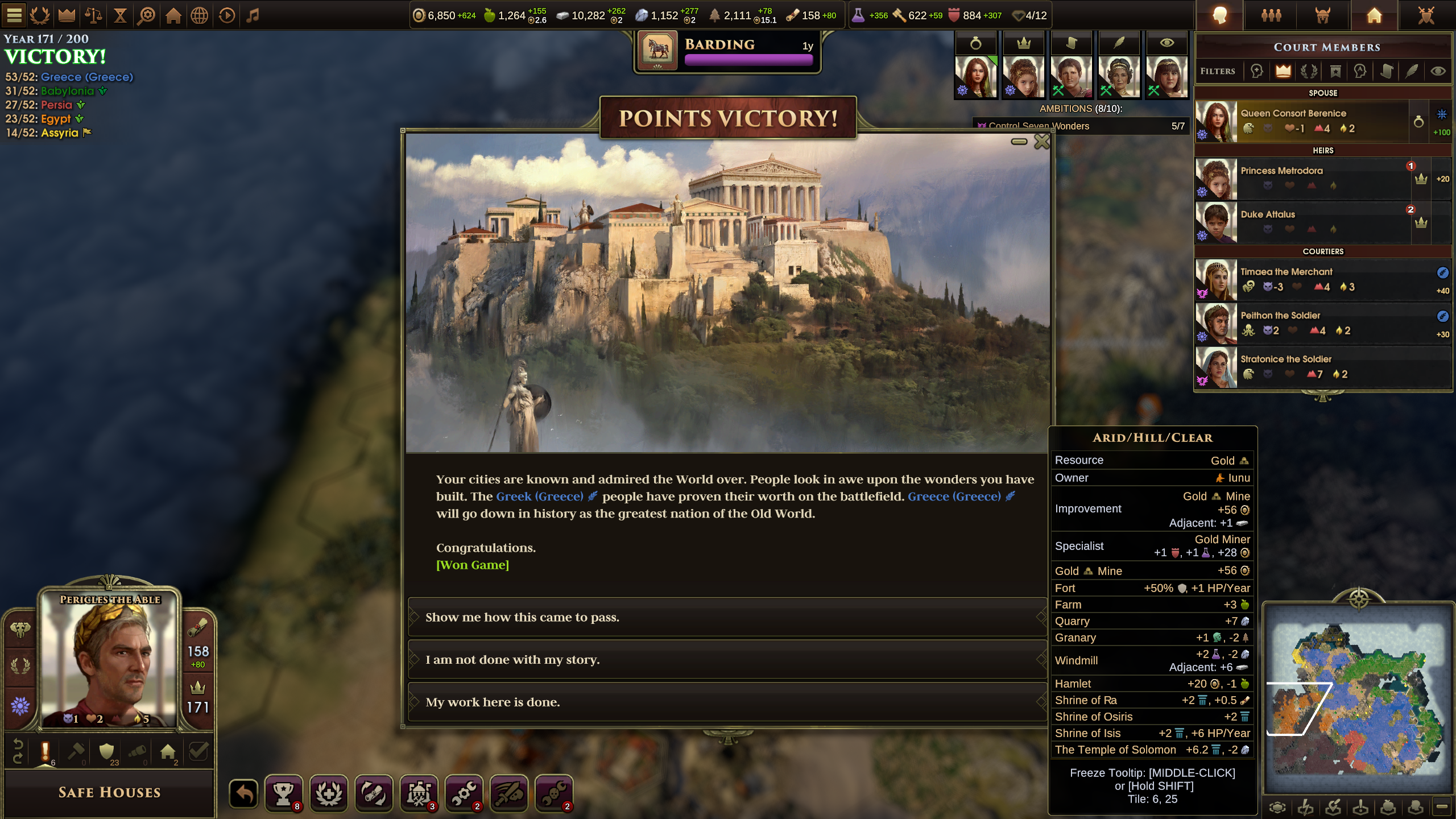
Information technology's a shame it peters out a bit towards the destruction. The victory conditions, honestly, rather suck in, and mostly go unexplained. The primary method acting of winning is by earning 52 points before 200 days have passed, which you handle nurturing your cities and building wonders. If nobody gets to 52, the highest wins. You can also get an earlyish win if you double the points of the next nation, but only if you're already central to 52. Then there's the Ambition victory, where you win if you manage to complete ten of what are essentially personal goals. If you get into't realised them in your life, they become fly-by-night bequest goals that your heir can complete, if they are degraded enough. Finally, you can just wipe away everyone out. IT's all a bit perfunctory, and a good deal more gamey than I expected. I was lucky that my first win happened flop as I finally conquered my curse Rome, because without that it wouldn't have been remotely unforgettable.
Despite its understated victories, Region is a brilliant 4X, and i that I'd actually recommend over Refinement at the second. It feels like a sincere step forward for the literary genre, boasting so many inventive, fresh designing decisions. And I can't consider I've reached the end of the review before even mentioning the especial soundtrack from composer St. Christopher Sn. Civ 4's Baba Yetu might still constitute my front-runner of his pieces, simply Sometime World is full of redolent orchestral and musical organisation compositions. There's a great deal to love here, and if you've got an itch to conquer the past world you perfectly need to give this a shot.
Old World
A clever Negro spiritual successor to Civilization full of both novelties and big ideas.

Fraser is the Great Britain online editor and has actually met The Internet in person. With over a decade of live, helium's been about the city block few multiplication, serving A a freelancer, news editor and prolific reviewer. Strategy games take up been a 30-year-long obsession, from tiny RTSs to sprawling political sims, and he never turns down the chance to jabber about Total War or Crusader Kings. He's besides been notable to gear up shop in the latest MMO and likes to wind down with an endlessly unfathomable, systemic RPG. These days, when he's non editing, he can usually be ground writing features that are 1,000 words too long. He thinks labradoodles are the best dogs but doesn't get to write about them much.

Source: https://www.pcgamer.com/old-world-review/
Posted by: browntherinchis1999.blogspot.com
0 Response to "Old World review | PC Gamer - browntherinchis1999"
Post a Comment